Change Our Thinking About Food

“I realized that the answer to the supposedly incredibly complicated question of what we should eat wasn’t so complicated after all, and in fact could be boiled down to just seven words: Eat food. Not too much. Mostly plants.”

Michael Pollan, Food Rules An Eater’s Manual

Recently a friend and I went out for breakfast and had a long chat about food. Specifically, we talked about the impact diet rules had on our thoughts around eating. She spoke about not eating fruit or carbohydrates from years of doing keto diets. Many diets, like keto, have hard rules about what one can and cannot eat, or do. These rules are presented, much like the gospel, as the answer to all our problems. One of the most commonly known rules, no carbohydrates allowed, has shaped the eating habits of millions of people and not always in a good way.

I have another friend who did the Atkins diet for years, which according to her interpretation, mandated no carbohydrates ever. She ate iceberg lettuce (not much nutritional value) and roasted chicken breast every day for years. I asked why she couldn’t eat vegetables instead of this type of lettuce and she informed me that vegetables had “a lot of carbohydrates” and iceberg lettuce was “mainly water”, making it a better choice. I remember trying to talk some sense into her, but she would not be swayed. She ate very little food throughout the day, as it was hard to “find things that had no carbohydrates.” I watched as she got very thin and honestly, sickly looking. I watched as her hair starting falling out, likely from lack of nutrition. It was truly disturbing for me to watch and she wouldn’t listen to any of my pleas to reconsider. My friend is not alone in letting diet rules shape her thinking, causing unintended consequences on their health as a result. These types of hard rules are something I have an issue with, and believe are causing food misconceptions that can do more harm than good.

The diet industry has in large part been the driving force behind many of these misconceptions, through the unchecked offerings of quick fixes and holy grails to being thin. There is no one way to be healthy that works for every body, as every body is unique and has individual needs, especially if you have a medical condition. That said, I’d like to take a look at a few of the major “rules” most followed and offer an alternative option to think about.

No Carbohydrates

This is one of the most popular diet rules people follow to lose weight. I would steer clear of any rule, or diet, that is based on completely eliminating an entire food group. The main issue is that the body needs carbohydrates to function properly. They are our main energy source and in fact our brains get at least 20% of their energy from carbohydrates.

That said, not all carbohydrates are the same, meaning we can make healthier food choices in this category. Although refined carbs can be harmful when consumed in excess, whole-food sources of carbs are incredibly healthy. Therefore, the quality of carbohydrates we eat are more important than the quantity. Rather than elimination of this much needed food group, it is recommended that we reduce our intake of refined carbs (white bread, white flour pasta, cookies, soda) in the diet and replace them with complex carbohydrates such as whole grains, fruits, vegetables and legumes.

Good vs. Bad Foods

There are truly no bad foods, as all foods have something in them that our body can use for nutrition. Obviously there are healthier choices we can make, but labeling foods good and bad can have a huge impact on our mental health. If I go out to eat, I should not feel guilty if I eat a piece of bread, eat a potato or drink a glass of wine. Attaching moral labels to food consumption is just not healthy for anyone, as that can lead to feelings of guilt and shame about ourselves, based on what we eat.

I prefer here to think about progress, not perfection when making food selections. Instead of avoiding perceived bad foods, I focus on making healthier choices. If I want to eat something less healthy, like a piece of bread, I eat it in moderation. Depriving myself of it will only make me resentful and want it more. There is no guilt to be had in eating food, just make informed choices when planning your meals. Don’t try to eat perfectly 100% of the time. Rather, do your best to select healthier foods and know that occasionally you may eat something less healthy. If I look at my personal eating, I went from eating mostly take in, or restaurant food, to cooking 90% of my meals. I have zero guilt when I do go out to eat and I try to select healthier options, but if there is something I really want, I will order it without hesitation.

Eat Everything on Your Plate

I was raised to believe that not finishing everything on my plate was bad. I was told that there were people starving in the world, who would be more thankful for the food and that not eating all of mine was wasteful. I am sure many of you can relate to that thinking. My parents were not bad people, that was just the thinking at the time, but we know better now. There is no reason to eat more than you need to eat to feel satisfied. Portions are mostly too big, especially in restaurants, even at home. Our body knows when it has had enough and we should listen to it. I have gotten much better at not forcing myself to “clean” my plate when eating.

When I eat, I have slowed down to give myself a chance to feel full. There is a delay in the body recognizing it has been fed, so slow down, take your time and I bet you will find you eat less. When plating food at home, I have significantly reduced the portions I initially serve. There is always food for seconds, if we are still hungry, so no need to pile it on the plate. When I dine out, I generally ask for a take home box when the food arrives. I put half of my food in the box before eating. I eat half the meal, pause, then if I am still hungry I eat more. If not, my box is packed and ready to go home.

Changing Our Thinking

Any food rule that is restrictive can do more harm than good. Restrictive rules seek to rule our choices with hard rules, such as – no carbs, can’t have fruit or elimination of entire food group. To overcome these rules, we need to start by looking at our own thinking and ask, “What rules am I living by?”, “What role does that have on how I feel about myself?” and “How does that shape my food selection?” Consider writing these thoughts down to help you really think about the impact this thinking has had on you.

To truly break free from these rules, one needs to create a healthier relationship with food. These past four weeks, I have been really examining my own thinking around eating. As I have said in this blog, I have been eating primarily whole food, plant based items to see if my gut health improves. That said, when I first shifted, I was overly focused on tracking my macronutrient intake. I engaged in the above reflection around my food thinking and came to realize, I had some food misconceptions deeply ingrained in my thought process. It is definitely a work in progress, but I am studying the research and trying to educate myself as a means to make healthier choices.

If you connected to something in this blog, please do reach out. I love the messages I get about your journeys. It’s always great to hear your thoughts and ideas and to know I am not alone on this path. You can reach me on by email at laurakump@reclaiminghealthblog.com, on Instagram or in the comment section below.
Cooking to Nourish Your Mind, Body & Soul

“No one who cooks, cooks alone. Even at her most solitary, a cook in the kitchen is surrounded by generations of cooks past, the advice and menus of cooks present, the wisdom of cookbook writers.

Laurie Colwin

The weekend after my high school graduation, I took my first apartment. At 18 years old, I wasn’t much of a cook and hadn’t had much appreciation for the meals my grandmother, or mother, had made. Fast food and cake were my main selections for meals. 

Newly married at 21, I had a small repertoire of recipes I could cook. It wasn’t extensive, but I could whip up some meat and potatoes and a bag of frozen vegetables. Pizza and baked ziti were my main selections for meals.

As a new mother at 25, I wanted to feed my infant son fresh foods, not foods in jars, as I was afraid of what might also be in them. I purchased my first crockpot and many fresh vegetables from the supermarket. I pureed these cooked vegetables and fruits and made homemade food for my son. Too tired to cook; pizza, baked ziti and tuna casserole were my main selections for meals.

Following the death of my beloved grandmother at 28, I took over hosting of all family holidays. I began developing the art of cooking the holiday meal from scratch. This was my gift of love to my family and helped keep family traditions alive. I really enjoyed doing it, however, too tired from raising three children and working full time, calling out for dinner was my main selection for meals.

When my mother was diagnosed with Alzheimer’s, I began cooking to keep my mind off watching her slowing leave us. Chopping up vegetables and onions became a form of therapy for me. Eating the delicious foods borne from following recipes and cooking shows, coupled with a nice bottle of wine became my main selection for meals.

Cooking is an art form and labor of love, but it is also one of the best things you can do for your health and well being. Cooking gives you control over what you are putting into your body, as you select and control the ingredients used. It is far healthier than eating fast food, or restaurant food regularly. The amount of fat and sodium consumed when eating out regularly cannot be denied. Cooking can be time consuming, especially at first, but I realized through my journey that it is truly worth the effort. 

Cooking has been so therapeutic for me and I cannot understate the joy it has provided as well. When journeying through the difficult walk of Alzheimer’s disease, it provided me great comfort, like a warm blanket. The cutting board, the chopping, the art of preparing a wholesome meal all brought calmness to my mind. Preparing family recipes kept me connected to family traditions and memories. It felt as if my grandmothers, mother and aunts were by my side guiding me along. Of course, there also was no denying the positive impact cooking had on my nutrition and health. Blood tests showed the improvement, as did my waist size and fitness level.

Cooking is love of self and family and likely the best gift you can give to yourself and them. It can be hard to do, especially when working full time, believe me I have been there. This is not a call to be tied to your stove, rather it is a call to see the value found in the art of cooking. With that in mind, here are some of the simple actions I took when starting out that helped me stick to it.

  • Plan Realistically – It’s easy to get overwhelmed, so plan out what you will cook and don’t take on too much at first. List meals you will prepare for breakfast, lunch and dinner. I use a calendar template to list the meals I will have for each day and include where to find the recipe. If you do this on your computer, you can make a live link to the recipe. You can also, reuse weekly plans as you go and create a rotation.
  • Plan for Shopping – As I pick meals, I list the ingredients I will need to shop for. I list items by the aisle they are found in, ex., Produce, Frozen, etc. This makes shopping quicker. I only buy what I need to reduce costs and waste, ex. if I need one sweet potato that’s what I buy, not the whole bag.
  • Plan for Leftovers – As I pick meals, I think about using leftovers for lunch and/or dinners. Example, a vegetable lasagna tray can be used for at least two dinners, or lunch and an additional dinner. So planning out the week, I take that into account. This cuts down on over buying and waste of food. It also removes cooking from several nights.
  • Recipe Selection – Choose recipes that don’t have a ton of ingredients. Less is often more when cooking. Focus on clean, healthy ingredients and flavors you love. There are so many offerings online and on Instagram. Find a cook you love and peruse their offerings.
  • Meal Prep – I don’t like spending a whole day cooking on my weekends, never did. There is value in prepping though to save time throughout the week. Breakfast is the easiest meal to prep for the week. If you have having overnight oatmeal, it’s very easy to make several containers at once and put them in the refrigerator, eliminating any need to cook in the morning. This week, I baked a quick oatmeal, buckwheat, hemp and quinoa recipe that was cut into eight slices for eight breakfast grabs. Other items I like to prep for are granola options for over acaci bowls, or cashew yogurt. Finally, salad dressing options are made to last a few days. 
  • Vegetables – I prefer fresh, but have started using frozen organic options for some recipes. This cuts down on the chopping time needed to prepare for recipes. Frozen vegetables and fruits have great nutritional value and can lessen the time needed to get a recipe on the stove.
  • Whole Food Plant Based – these recipes take less time to prepare than most meat recipes and are great options for a work night. I made a delicious red lentil, walnut and mushroom bolognese sauce last night that was cooked and on the table in just under 60 minutes. These meals are also easier to digest in the evening when you may head to bed earlier.
  • Prepare Before Starting – I pull out and line up all ingredients I will need prior to beginning a cooking session. It takes a few extra minutes up front, but is well worth the time. I even measure out the spices and have them ready to just put into the pan. All of this makes following a recipe and cooking so much easier! I promise.
  • Clean Up as You Go – I clean and put things away as I go, making it so much easier when we are done eating to clean up. Leaving everything in the sink and out, as my husband would do, makes it feel overwhelming and messy. Once something is on the stove simmering, or in the oven, it is the perfect time to clean up and put things away. This often leaves me with only dinner dishes to rinse and put in the dishwasher when we are finished eating.
  • Start Small – If you are new cooking, or haven’t cooked in awhile, start small. Commit to cooking one meal a day for the first week. This will keep you from feeling overwhelmed. You can add other meals as you go, when you feel ready.

I hope you found something helpful in these suggestions. Go easy and give yourself grace to find what works for you. The most important thing, is that I hope you cook. 

We talked about doing something new to spark motivation in last week’s post. Perhaps cooking can be that something new. I truly hope it is. If you are already in love with cooking, please share some ideas with me through email at laurakump@reclaiminghealth.blog , Instagram @reclaiminghealthblog or in the comment section below. 

Try Something New

“I always did something I was a little not ready to do. I think that’s how you grow. When there’s that moment of ‘Wow, I’m not really sure I can do this,’ and you push through those moments, that’s when you have a breakthrough. Sometimes that’s a sign that something really good is about to happen. You’re about to grow and learn a lot about yourself” -Marissa Mayer

As we enter February, we may have lost some of our mojo when it comes to work out promises made at the New Year. The initial excitement about getting into shape may now be starting to wane. I know the crowds at the gym here have started to diminish greatly, as happens every year. It’s the same cycle every year and one that gets even the most well intentioned of us, myself included. This year however, I made a promise to myself that I would not give up on my journey during these cold winter days. This year, I made a promise to myself that I would not have to start over from scratch come spring.

Sometimes when motivation starts to dwindle, trying something new can be just the spark you need to keep going. Switching things up and adding some variety to your routines can be the ticket you to hold on. For me, I have added in very short runs to my week and started a WFPB (whole food, plant based) nutrition course. Both have served to peak my need to learn and grow and push through these moments of wanting to nest in my home under a blanket.

I was not planning to add a plant based certificate to my coursework, but have been struggling with some gut health issues recently. After researching and truly reflecting on it, I felt the time was right to explore my long standing difficulties with getting enough fiber in my diet without supplementation. I have a long history of not loving vegetables and irrational thinking about the sugar found in fruit. I decided it was time to dive deeply into the world of plant based nutrition and felt WFPB was the best place to start. I was definitely not sure I would be able to survive, much less thrive, if I only ate whole plant based foods.

This is my second week of eating WFPB and I must admit that I actually do feel better. I had some diverticulitis symptoms and was beginning to worry, but this week I haven’t felt the nagging pain on my left side following eating. It’s far too soon to tell the true impact, but I am most definitely motivated to keep going. I am excited to continue to learn and try new foods and track my growth in the process.

If you are feeling stuck and losing motivation to eat healthy, workout or do any of the things you loved, consider trying something new and see if it reignites your passion. Is there something you’ve been wanting to do, but haven’t? It can be anything, not just health related items. Have you always wanted to learn to crochet?, Wanted to learn about plant based cooking? Whatever it is, do it! It could be just what you need to climb out of the winter freeze and move into the spring thaw with stronger motivation. 

In my case, I knew my intake of vegetables and fruits was weak. I started thinking about it and researching it. I then took the following steps:

  • Learn – It’s important to engage in the process of learning new information. It is great for your brain and can build excitement around the process, as well as give you the tools you need to try it.
  • Add On – What are you already doing that this new learning will improve? I love to cook and was excited to add new recipes, ingredients and meals to my repertoire. As a health coach, I knew I would interact with clients who have different preferences for their foods and wanted to build a better knowledge around this topic.
  • Connect – Find others who share your passion. One of the blessings of social media is that you can find your tribe as you learn and grow. I found a group of WFPB people who have offered support and ideas as I learn. 
  • Push Through – Decide to do it and really try to stick to it. Focus on progress not perfection and do what you feel you can commit to right now. In my case, I went cold turkey, but that is because I am not working full time. If I was still working, I would have likely committed to add one WFPB meal to each day. 

Whatever you decide to do, give yourself grace. The goal is to spark motivation, not overwhelm yourself. Remember, it’s the small steps that add up to big change, but that won’t happen if we get overwhelmed. For example, if you want to learn to crochet, don’t set out to make an afghan right from the start. It’s likely best to start with making one chain of stitches. Once you have that down, move to making one full square block. Finally, over time you will move to making an afghan blanket. Using these small steps over time, you will hold on to your motivation as you celebrate those successful moments along the way.

I’m excited to hear about your new passions and how they helped motivate you to keep moving forward. Please do reach out to share them with me at laurakump@reclaiminghealth.blog , on Instagram @reclaiminghealthblog , or in the comment section below.

Eat to Live

I don’t have a diet. Jenny Craig got a diet. Seriously. I eat to live, not to die.

Bernard Hopkins

There are so many quotes attributed to Ben Franklin that we hear still today.  “Eat to live, don’t live to eat’’ is one of those quotes. Franklin believed that eating in excess should not be one’s favorite activity, rather they should eat to stay healthy, not over indulge. Further, he feels that eating shouldn’t be your favorite activity, but rather what you do to be healthy. While you may not agree with Franklin’s philosophy, it’s important to note that he lived for 84 years, which is well above the average lifespan of his time.

There seem to be two schools of thought on this topic, eat to live vs live to eat. I have been in love with food for most of my life. I love to cook and get so much happiness out of preparing a delicious meal for my friends and family. I also have been an emotional eater most of my life, using food to eat my emotions and feelings. Food has been a great source of comfort during the difficult times of my life. These actions put me solidly in the live to eat category. I love to plan menus, shop for ingredients and create tasty meals. Food has been much more than fuel for me and many times my day revolves around what meals I will be eating. 

On this health journey, I am trying to shift my relationship with food to find a healthier balance. Knowledge is power, so I have been studying the role of nutrition on aging and longevity. There is so much to dive into and I am at the beginning of this learning, but my goal is to focus on what I need to eat to live. I can definitively say that I have not been eating foods that will help me live to see my 84th birthday like Ben Franklin did. I have long been a vegetable hater and most meals didn’t include vegetables or fruit on my plate, aside from the salad. 

Understanding what food makes me feel energized and what food makes me feel sick is an important first step. I have been exploring whole food plant based meal planning to improve my health. There’s excellent scientific evidence that many chronic diseases can be prevented, controlled, or even reversed by eating a whole food, plant based diet. 

A whole-food, plant-based diet is based on the following principles:

”Whole foods”: That means whole, unrefined, or minimally refined ingredients.

“Plant-based”: Food that comes from plants and is
free of animal ingredients such as meat, milk, eggs, or honey.

My readers know that I am about simplicity always and this shift feels huge for me. It is not realistic to expect that I will go cold turkey and eat only plant based meals from day one. To make this shift feel more doable, I have implemented the following shifts:

  • Progress not perfection – I am giving myself grace knowing that small changes will have a compound effect and not sweating the slip ups along the way.
  • Focus on one meal at a time – Reworking my whole menu at once causes major stress for me. I am focusing on one meal at a time. My breakfast was clean, so I am leaving that alone for now. I am focusing on my main meal of the day and trying to rework that to WFPB.
  • Reduce animal products – I am working to reduce animal and dairy products, but again it’s not all or nothing. Thinking about “never” eating a meatball, or mozzarella cheese again causes major FOMO for me. Right now I am hoping to introduce meatless days with the premise that they will increase in frequency over time.

An eating to live approach suggests that we need variety and essential nutrients. My living to eat mindset adds the emphasis on pleasure and enjoyment. I believe both mindsets are essential to my success, which is why I am taking it slow and hoping that the natural shift to craving more nutritious foods happens over time. Then I know I will feel the same sense of pleasure in planning, cooking and eating these healthier foods. I will let you know how it goes. 

For more information on WFPB eating, check out Eat to Live by Dr Joel Fuhrman and Forks Over Knives Plan:How to Transition to the Life-Saving, Whole-Food, Plant-Based Diet. Also, check out the Blue Zone and You Are What you Eat A Twin Experiment, both on Netflix.

If you have any questions, or want to share your journey, please reach out to me at laurakump@reclaiminghealthblog.com , on Instagram , or in the comment section below. 

The Compound Effect

“You will never change your life until you change something you do daily. The secret of your success is found in your daily routine.”
― Darren Hardy, The Compound Effect

I first read Darren Hardy’s book many years ago as a new school leader. The Compound Effect outlined, is the strategy of being consistent with smart, tiny choices over time that will produce significant results. As I read the book I was focused on leadership, yet in the back of my mind I kept connecting back to my health journey. The concept is that smaller steps over a long period of time will have a greater, more beneficial and successful effect on your life than bigger steps in a shorter period of time (that most people will not stick to). Today as I view the predictable dwindling off of the New Year’s resolutionists at the gym I am reminded of this concept.

For many years, I was that person. The one who gets all pumped up for the reclaiming health journey. Those who have followed me over time know that every spring I have a rebirth and start over. Then, every winter I slowly fade away and fall backwards. This year has been different, albeit not easier. The temptation to fall back has reared its head repeatedly, especially on these 18 degree days. Using the concept of the compounding effect, I know that consistency is the key to achieving and maintaining momentum. I have held tight to that concept on my darkest of days this winter and continued with the small, simple habits and daily routines that will add up to a healthier life. My goal this year was to make it through the winter with habits in tact and see where I am come spring. As we are nearing February, I am very hopeful that this year will be different for me. 

Consistency is not easy if you make your habits too lofty, the key is to keep things simple and doable. When I selected daily habits, I’d say I even set the bar lower than I knew I could accomplish this winter. This helped me through the harder days and gave me added bonus boosts when I achieved more and kept me motivated. We all know success fosters motivation and failure often motivates quitting. For my movement goal, I merely set a minimum of a 30 minute walk in nature goal for every day of the week. This goal has been the easiest one to maintain, rain or shine. Setting a doable goal like this sets you up for success and avoids repeated failure that can serve to make you feel like a failure and give up. Obviously, it’s not my only fitness goal, but it’s the one I will never skip. Walking and being in nature cannot be undervalued on any health journey.

Another doable goal I set was to improve my nutrition through simple choices for my meals. I made a commitment to have a healthy breakfast every day. To make it easier, I decided to to a morning smoothie with protein and healthy nutrients, using simple recipes found in Joyfull, by Radi Devlukia. This sets me up for my morning workout and keeps me full until lunch. There are so many great smoothie recipes, but if that feels overwhelming just use a high quality protein powder shake, such as this one from Complement. I like the chocolate flavor when drinking plain and unflavored when using with the recipes from Joyfull. I have been super consistent with this goal as well. No cooking required for this breakfast and the variety of smoothies is endless. For lunch, I generally eat the main meal of the day to allow more time for digestion. I eat a whole food plant based diet consisting of protein, legumes, fruits, vegetables and whole grains. This also is very easy to do as salads are super easy to put together. 

On this cold winter day, I remind you that it’s not about perfection. It’s about the effort we put in and more importantly, the consistency we apply to our health journeys. Approach every day with a clean slate. If you ate too much yesterday (me eating pizza during the football playoffs), it’s all good, just return to your daily routine today. You slept in and didn’t do your gym workout this morning, get up do your 30 minute walk and return to the gym on your next scheduled day. Perhaps your body needed the rest. What we can’t do is give up and stop. Just keep to your routines as best you can and watch the compound effect unfold. 

If you have any questions or comments, please do reach out. I love getting emails at laurakump@reclaiminghealth.blog about your journey. Take a photo of nature from your 30 minute walk and tag me on Instagram at reclaiminghealthblog with #30minutesinnature . Let’s do this together, motivate each other and reach spring feeling healthier. It is only two months away!

Green Means GO

“Life is really simple, but we insist on making it complicated.” — Confucius.

One of the most complicated parts of a healthy lifestyle, for me, is meal choice and planning. Knowing what to eat can really be the make or break of feeling successful. For many years, I have thought I was eating healthy and could not understand why nothing changed. I would eat foods I perceived as healthy and feel good about my choices, only to find out what I thought was healthy wasn’t healthy for me at all. This can be very frustrating. Far worse, the complexity of this can be very overwhelming and truly make one feel like giving up.

Anyone who has read my blog knows that I am about keeping it simple to keep it accessible for all. I need simplicity to feel motivated. Weighing food, calculating macros, meal prepping and all those other strategies are good, but have not been sustainable for me for many reasons. In order to avoid that, I invested in a good food logging app to better understand my eating habits. I have used My Fitness Pal for years and when in doubt about my eating patterns, I always go back to logging to see what is happening. Another app I have used is Noom, an app meant to teach you about your eating patterns by categorizing foods into categories, not based on good or bad, but rather on how much you should consume of each. Both are great apps to gain insight into your eating patterns and uncover why you are not getting the results you want.

Another simple tool I use is Dr Sears Wellness Institute’s Traffic Light Eating which I learned about during my Health Coach certification courses. Traffic Light Eating is based on the familiar concept of driving a car. A traffic light is meant to guide use when driving and can be used in the same way when making choices about food. It’s so simple, Dr Sears uses this with his pediatric patients! 

Green means “go”
Yellow tells us to “slow down”
Red means “stop” and think

Again, like Noom’s system, there are no judgements made about foods we eat and doesn’t ban foods. We all know that taboo placed on foods can make them more desireable. Rather, this tool focuses us on how often and how much of certain foods we consume. Below are the breakdowns of each category on our traffic light used to help us when making selections of food.

Green Light Foods

Green light foods include all fruits and vegetables. They are grown and not manufactured or process artificially. These foods are low in calories and high in nutrients. They provide color to our plates and can be eaten raw or cooked. Green light foods are foods which can be eaten generally free of worry, barring any personal health issues you may have. They are considered go foods and make great choices for all meals and snacks and should play a prominent role in your selections. They were also the group I noticed I wasn’t eating enough of.

Yellow Light Foods

Yellow light foods are fine to eat everyday, but in moderation as they are considered slow down foods. You do not have to give them up, or feel badly if you do eat them. These are the foods, I learned, made up my entire diet. Yellow light foods include: pasta, rice, bread, tortillas, noodles, eggs, lean meat, chicken, low fat yogurt, nuts and seeds, olive oil, soy foods, whole grains, fish, low fat cheese, and vegetable oil.

Red Light Foods

Red light foods are known as “stop” and think foods. We don’t have to eliminate them entirely from our lives, but we should look for different options, or eat them less frequently. When we do choose then, we should pay specific attention to our portions and go smaller. These foods are low in nutrients and high in calories, fat or sugar. Many contain artificial sweeteners or trans-fats. Think about that cookie you ate last night, that would fall in the red zone. You wouldn’t want to eat the whole bag, or eat them every day, but one cookie will not make you fat or a failure. This group, I learned, was my go to group especially when tired, upset or super hungry.

All these tools are very easy to use and guide you as you learn more about your food choices. I appreciated that none of them made me feel badly about myself for my eating patterns. Rather, they seek to empower you through building your knowledge about food. I find myself making better choices in my overall daily eating, including when eating at a restaurant. The biggest change for me was in increase in my intake of vegetables and fruit. 

I recommend you start by looking at your pantry, refrigerator or dinner plate. Start to think about which category the majority of your fall falls in. No judgement, just notice. If you don’t want to do this, I recommend you think about using an app to guide you. Log your food and notice what the analysis tells you about your food patterns. Once you have this data, you can make some adjustments to your food selection and notice what impact it has on you. They say what gets measured gets improved. I fully agree, but what I’d like to measure is not my quantity of food, but my knowledge about the quality of it. 

If you have any questions about the apps, or traffic light eating, feel free to reach out through email at laurakump@reclaiminghealth.blog , Instagram or through the comment section below.

Hold On

Coming out of the holidays, I found myself feeling under the weather. It is so hard to stay on track when we aren’t feeling well. Our body needs rest and we want to keep pushing, but rest is what we need. I’ve learned that our body knows best what it needs, if we choose to listen. This time, I chose to listen. 

I was in bed for a week with the flu at the holidays. Initially, I wasn’t hungry at all. After, I was so hungry that I found myself craving foods I haven’t been eating, think pizza, pasta and snacks. In the past, this time of year was always when I went down the rabbit hole, beat myself up for being lazy and gave up. If I look deeply at my health journey, I see the patterns so clearly. Spring and Summer, highly active periods with good habits, motivation and weight loss. Fall holding steady. Winter lower energy period with weight gains and loss of interest in healthy habits. When I was young, I used to call it my hibernation period during which I needed the extra weight to get through. It just became the normal flow of my life.

If you’ve been following my journey, you know how central being outside in nature is to it. I believe strongly that being outdoors has helped me physically and emotionally. I realize now that the patterns I’ve cycled through each year, make perfect sense as part of the cycles of nature where I live. It is normal for me to have slightly less energy during the wintering period. Knowing this helps me feel better about myself, but I want to be clear it doesn’t give me a pass to give up on my healthy habits, which is what I have done every year. 

I recently read a quote that said, if you want different results, you have to do something different. Common sense for sure, but research shows habits are hard to change. For me, I’m keeping it simple this year. I am holding on as best I can. I wake up each morning with good intentions and a plan.

  • I drink my healthy morning shake no matter how I feel, or what I did or didn’t do the day before. 
  • I try to eat healthy foods, but allow myself forgiveness if I veer off course.
  • I move my body every day, rain or shine no less than 30 minutes a day outside in nature. 
  • I get at least 8 hours of sleep and try to maintain my sleep schedule.
  • I found an indoor space so I can continue to play pickleball four times a week.
  • I am now back in the gym lifting light weights at least twice a week.

The best advice I can give is to hold on tight to the goal of a healthy life. It is the most important work we will ever engage in. It’s truly easier to give up, hibernate an just give up. That will only leave us back at it in the Spring and redoing what we have done each year. This year, I hope to start my high energy period in much better health space than any year before. I hope you will join me in that goal. In order to do that, take some time to reflect on your health patterns across the year. What do you notice? What does that mean for you at this moment in time? Most importantly, what will you commit to do this year?

Please let me know what you decide and how it goes. Sharing your journey will help us all to learn and grow. Leave a comment below, visit me on Instagram or email me at laurakump@reclaiminghealthblog.com . I look forward to learning together.

Things I’m Letting Go Of

 “Authenticity is the daily practice of letting go of who we think we’re supposed to be and embracing who we are.”

— Brené Brown

2023 was quite the year of change for me, not because I wasn’t good enough as I was, but because it was needed to thrive. Fate has a way of getting our attention sometimes and you just know it’s go time. My health was at what I’d describe as my lowest place and it was starting to manifest itself in scary ways. I felt like I was struggling to think clearly and the lack of sleep for months was starting to put my body in a dangerous health space. Having the option to retire, but not feeling it was the right time to do it, fate gave me the clear signal it was time. My husband became ill suddenly in late November 2022 and required surgery. With a 90% blockage in what is called the “widow maker” artery in his heart, I realized just how close we came to losing it all. These life events really make you stop in your tracks.

Realizing just how lucky we were to have gotten through this, I knew it was time to make some changes to my lifestyle choices. My husband was in far better health than I was, or so we thought, so I worried about what was happening inside my body. Following full medical checkups, I began again the journey to reclaim my health. Where in the past, it may have been easy to become derailed, this time I knew the actual stakes involved in making these necessary changes.

2024 will be the continuation of this journey as I continue to focus on learning and growing my knowledge base to improve my choices. I am continuing my focus on self growth and plan to take a deeper dive into my yoga practice starting this month. I am taking a yoga teacher training course to deepen my understanding of Hatha yoga. Self reflection will remain the cornerstone of my work when it comes to life choices and health. With that in mind as I begin 2024, I am reflecting on things I will be letting go and things I will grow. 

Things I Will Be Letting Go Of

  • Making assumptions - I have no way of knowing another’s motives, so I will not engage in trying to.
  • Negative self talk – I am breaking up with my inner critic.
  • Overthinking – I can’t analyze everything
  • Saying no too quickly
  • Alchohol – I never knew just how much it ages me
  • Doing too much – Overdoing just exhausts me and I don’t have to do it all
  • Fear of failure – I don’t have to be perfect all the time to succeed, especially as I try new things

Things I Will Grow

  • Relationships – Continue making new friends and deepen the relationships I have
  • Self Love – Continuing to be kinder to myself through self reflection and meditation walks
  • Saying Yes – Stepping outside the comfort zone and trying new things. Adding to the bucket list.
  • Boundaries – Being more conscious of creating healthy boundaries as I engage in my relationships.
  • Healthy Lifestyle – What can I learn and do to continue on this journey?

These are my thoughts as of today, January 2, 2024. I am sure there are more items I need to reflect on and will grow or revise this list as I go through the year. What can you let go of this year, what can you keep and grow? I’d love to hear about your journey, so feel free to reach out through email at laurakump@reclaiminghealth.blog or comments below. May you have a healthy and happy year of growth in 2024.

I Am Enough

“You are enough, just as you are. Each emotion you feel, everything in your life, everything you do or do not do… where you are and who you are right now is enough. It is perfect. You are perfect enough.” – Melanie Jade.

“The single most revolutionary thing you can do is recognize that you are enough.” – Carlos Andres Gomez.

This time of year always seems to put so much pressure on us all. Coming out of the holidays, where perhaps we ate and drank more than usual, we can be upset with ourselves for our lack of ability to control ourselves. Couple this with being inundated with commercials and advertisements for the new year and all its promise to change our ways and start anew. Deeply rooted in these promises are the premise that we are imperfect and in need of changing. The new year, new you machine has long been a multimillion dollar business that preys on our deepest insecurities. 

Gym memberships, diet pills, meal plans and quick fixes are so successful because we all want to believe that we can change ourselves into a better version. Sadly, come February we likely will confirm what we knew all along, we are incapable of reaching perfection. The gym trips will stop, the diet pills will go in the trash and we will settle in to the acceptance of yet another year of failed promises.

This year, I’d love to see us say no to this idea that we are not perfect. A few years back, my daughter gave me a coin and affirmation to remind me that I Am Enough. I have read it and reread it and really tried to internalize the message. I think I have finally reached a new year in which I am not striving to change myself. Amen!

The best advice I can give is that acceptance of yourself, AS YOU ARE, can and will lead you to a healthier space. There is nothing we need to change, fix or get rid of. Wherever we are in our journey is enough. Remember, I am not on a diet, nor looking to lose weight to be thinner, prettier or happier. I am trying to live a healthier lifestyle to be healthier and hopefully a longer and fuller life. 

Reminding ourselves daily that we are enough as we are is important work. The feelings of inadequacy are often deeply rooted in our being and our inner critic has been empowered for years. Taking back our power is the work to engage in during this new year. Reminding yourself daily, especially when self doubt creeps back in is your action plan. Every time you look in the mirror remind yourself that you are enough just as you are. Every time you feel the inner critic rear their ugly voice, remind yourself that you are enough.  Put a sign on your mirror, your closet, inside your front door and your refrigerator! Say it, breathe it, chant it and most importantly live it. Find others who will support you on this mission, for free. You are worthy and so am I. 

I truly believe in the power of positivity, though I cannot promise it to be the easiest road. It is not a quick fix, but it can be life changing. Let’s make a promise to ourselves this year to stay strong in our belief that we are enough, just as we are right now. We have nothing to change or fix. We are enough just as we are.

Have a healthy and happy New Year. I look forward to sharing your health journey in the coming months. 

The Rule of Twos:Eating Habits for Better Health

Last week, we discussed inflammation and the impact it can have on our health. As part of my health certification course, we spent a lot of time learning ways to improve our health, including diving deeply into our eating habits. I personally have struggled with inflammation and the effects it has on my health. I mistakenly assumed I could diet my way to good health for years. The problem with that is the word diet, and believe me I have tried them all and had the same results, weight loss followed by weight gain with little impact on my overall health.

I first learned of inflammation, back in 2010, when I was diagnosed with rheumatoid arthritis, which is arthritis caused by inflammation. That was the first I learned that certain foods have the power to make us feel better, or worse when we consume them. During this coursework, I went beyond this understanding and added the knowledge that my actual eating habits themselves have an effect on inflammation and overall gut health. 

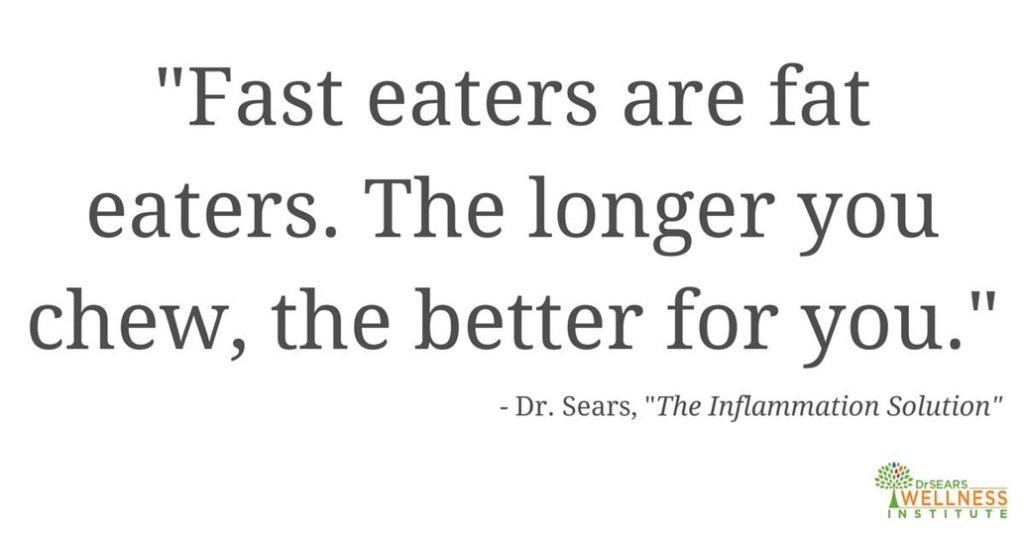
The Rule of Twos and the opening quote shared above, ”Fast eaters are fat eaters, has my name written all over it. Anyone who knows me, knows I am a super fast eater. As kids, we were taught not to talk with our mouths full, so eating was serious business. Eat, then we could talk, laugh and linger. I had no idea that this habit could actually impact my health, especially my gut health. I thought it was more important to focus on what I actually ate. I have heard to slow down my eating, but thought the main reason was to allow the brain to catch on to the fact that it had been fed. 

The Rule of Twos, is simple and has absolutely helped improve my eating habits. Further, it can help with inflammation, indigestion and constipation. The rule simply reminds you to:

  • Eat twice as often.
  • Eat half as much.
  • Chew twice as long.
  • Take twice the time to dine.

Grazing, or eating smaller amounts of food, throughout the day is a new approach to eating for me. On a good day, when working, I ate one big meal and maybe a yogurt at night. This grazing approach can decrease spikes in your blood sugar levels and help stabilize your insulin levels throughout the day. Eating less can also improve your digestion as your body has less food at once to metabolize, or digest. I find it very satisfying to eat this way and enjoy my healthy snacks as well. The trick there is to have things on hand to nibble on during the day, greek yogurt, humus, cut raw vegetables, fruit and nuts make great, easy to grab and go snacks. 

Eating half as much will help me eat less, but I think of it now as letting my body tell me what it actually needs, guiding my portions. When I make my plate now, I put half as much as I used to on it. When I finish eating that, I pause before even thinking of taking seconds. Most days I realize I don’t need to eat anymore. As the weeks have passed, I find myself satisfied with this new portion size, even when eating out. 

Chewing twice as long is something I am working on as a recovering fast eater. Chewing can definitely slow me down, but there is far more to this than just that fact. Digestion, I’ve learned, starts in your mouth, not your stomach. When you chew your food, it gets broken down into smaller pieces which are easier to digest. When mixed with saliva, chewing allows your body to extract the greatest possible amount of nutrients from the food you eat. This is why it is said you should not drink with, or immediately after eating. 

The last part of taking twice as long to dine, allows me to spend some quality time at the table relaxing and reflecting. In the past, once I was done eating, I would get up and immediately start cleaning up. Now, I spend some time at the table, engaged in conversation, if I am not eating alone. If I am alone, I take some time now to jot down thoughts in my daily journal, or just relaxing before cleaning up.

The Rule of Twos is super easy to incorporate into your wellness routine, with nothing to buy or study. The changes are indeed small, but the impact on your health and wellness will be large. Why not give it a try for a few weeks and see how you feel? If you do, please let me know how it went. Have questions about how to get started, shoot me an email, or leave a comment and I’ll get back to you to brainstorm a few ideas.